At Utah Scoliosis Center Physical Therapy, we understand how frustrating it can be when pain or injury prevents you from enjoying your favorite activities. That's why we offer a comprehensive range of Scoliosis Specific Exercises (SSE) designed to help you recover from injury, manage chronic pain, and improve your overall mobility and function. Our team of experienced therapists will work with you to develop a personalized treatment plan that addresses your unique needs and goals.

The rate of progression for scoliosis patients differs greatly by age. However, regardless of the patient’s age, our goals are similar: to stop and reduce the progress of the curve.By strengthening the spine in a corrective position, it becomes more resistant to scoliosis progression. This approach can normally involve multiple types of treatment such as chiropractic, exercise therapy, active rehabilitation, passive rehabilitation, and corrective bracing. Adolescent idiopathic scoliosis is a common type of scoliosis that benefits from this approach, but our approach works for many other types of scoliosis as well.
We have designed programs understanding that scoliosis rehabilitation cannot be like traditional rehabilitation for it to be effective. Our treatment options condenses the duration and increases the intensity of the treatment. This intensive formula is what provides the ability to overcome the progressive nature of scoliosis. Intensive does not mean painful; it simply means lots of treatment in a short period of time. Pain management, through mobility and flexibility exercises, is also a key component of our approach to ensure patient comfort. Research shows that specialized scoliosis bracing can be an effective non-surgical treatment for scoliosis. We compliment our specific scoliosis exercises and state-of-the-art mobilization devices with our advanced bracing from ScoliBrace®
A to Z process
We like to provide a brief overview of every step of the treatment to help provide patients with an example of a typical treatment session, so they know what to expect and can prepare accordingly.
After a consultation with our doctor reviewing past medical history and background scoliosis information, we will perform a comprehensive physical examination. The purpose of this exam is to maintain standards of care, collect data that may be used for research purposes, and ensure that the patient will not have any trouble tolerating any of the therapies and procedures utilized in our clinic. The physical examination includes posture pictures, various orthopedic tests designed to test your neuro-musculoskeletal function, balance & proprioception, scoliometer measurements, spirometry, and a neurological exam. After this, a series of precision x-ray views are then obtained which will provide us the information needed to best adjust your spine and formulate a specific spinal exercise regimen customized to your spine and your x-rays.
Lastly, we will review with you your x-ray findings, our report of findings, our recommendations for care, dietary recommendations, specific spinal isometric & scoliosis stretching exercises, and then commence to your first treatment session.
Every treatment session begins with the patient signing in at the front desk. Then, the “Mobilization” stage of the process begins with the Active Rehabilitation Chair (a.k.a., the “Wobble” Chair). This is a seat mounted on a pivot that improves range of motion while stretching muscles, raising the core temperature, and increasing spinal flexibility to prepare the spine and enhance the effectiveness of all subsequent therapies.
The next phase in the warm-up or “Mobilization” stage is the Vibrating Traction or V/T. Research conducted by scientists specializing in spinal biomechanics found that certain vibrational frequencies have the effect of relaxing the tendons, ligaments, and intervertebral discs. This vibration is very beneficial in treating scoliosis, due to the “bow string” effect of the ligaments & tendons and the disc wedging that occurs in the concavity of the curve. The patient lies down with the V/T under their neck or low back, and a gentle vibration is transmitted to the spine. Most patients find this therapy very relaxing!
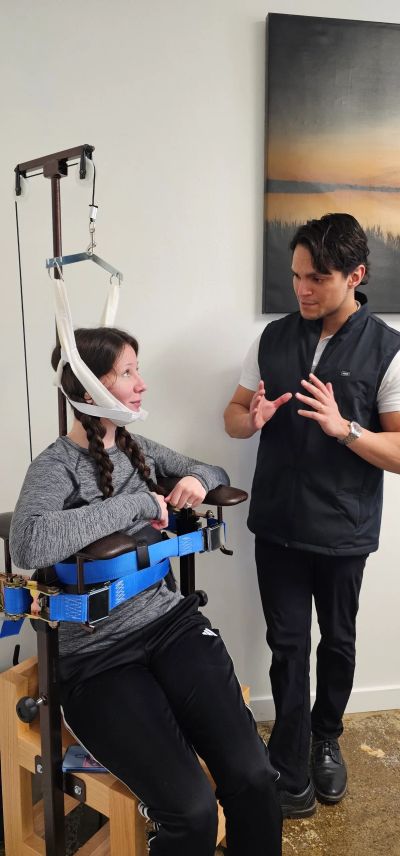
After the V/T, the cervical traction unit is used to help traction the spine and restore the natural sagittal (front-to-back) curves of the spine. It is essential to restore the normal biomechanics of the spine to reduce the overall severity of the scoliosis. The cervical traction consists of two pieces, a curved piece, which is placed behind the neck, and a straight piece that goes under the chin. While standing, the patient bends their knees, and applies a gentle pressure to the head to traction the spine. This is done repetitively 100 times. Next is the Core Muscle Stimulator. This form of percussive massage therapy (tapotement) has been FDA-approved since 1988, and it is extremely effective in relaxing the core postural muscles that are often tight and guarded due to the scoliosis.
We have collected hundreds of pages of research on this method, and it has been proven to be 68% more effective in reaching the deep muscle groups. A 30 second use releases muscle tension by as much as 65%. This method is widely used by physical therapists and rehabilitation experts and is also employed by many professional sports teams. Core muscle stimulation is very safe, and, while it can be challenging to the patient (as we are targeting muscles that are often overworked and sore), it produces no more discomfort than a deep tissue massage. Many of our patients report improvement in their sleep habits and decreased muscle pain after this therapy.
Once the soft tissues of the spine are relaxed, we begin mobilization of the fixed portions of the spine using a Flexion/ Distraction table. The lower half of this table moves slowly up and down, which alternatively stretches and relaxes the spine, and improves spinal health & segmental motion, especially in the wedged discs and other areas of the spine which are not moving like they should.
The patient is placed face down on the Flexion/ Distraction table, which has
been customized with special scoliosis brackets & straps to induce a “mirror-image” configuration in the spine. While you are on this table, the lateral traction straps pull the spine straighter, and the repetitive lowering & raising of the bottom half of the table create a natural “pumping” action in the inter-vertebral discs, promoting spinal health and increasing spinal motion. To achieve the best possible correction, these straps are secured very tightly, which may be mildly uncomfortable, but the soft leather pads are incapable of causing injury. It’s important to understand that treating scoliosis effectively requires the spine to be placed in a position which it does not normally assume; the less we are able to stretch the spine towards the opposite direction, the less the soft tissues (muscles, discs, ligaments, & tendons) will re-model and change, and the “rebound” effect of these tight muscles & ligaments will decrease the permanence of the achieved correction.
The last “Mobilization” procedure is a Mechanical Drop Piece (MDP).
This piece of equipment utilizes the same frequency of vibration as the V/T, but the two pieces of equipment have unique functions. The V/T applies primarily to the cervical & lumbar spine in the sagittal dimension, treating the loss of the normal spinal curves in these areas. The MDP affects the thoracic and pelvic spine in an axial/coronal plane, addressing translation and rotation. The MDP uses a large fulcrum to affect larger spinal angles and uses more force and greater displacement to affect the massive ligaments of the pelvic girdle reducing the rotation of the sacral base and pelvis. The benefits will be most apparent in patients with a great deal of pelvic rotation.
The second part of the treatment is the adjustment stage. This consists of specific chiropractic adjustments, performed with the aid of precision adjusting instruments and drop pieces. All of the adjustments are performed based upon the analysis of your specific x-ray configuration, and are specific & unique to each patient. This precision adjusting technique is different than the traditional adjustments performed in the majority of chiropractic clinics; because of the great deal of time required to master & apply this technique, it is used by only the most advanced chiropractic spinal specialists.
The last stage of treatment is labeled the stabilization phase. It is a combination of exercise therapies designed to strengthen the postural muscles responsible for maintaining the achieved correction.
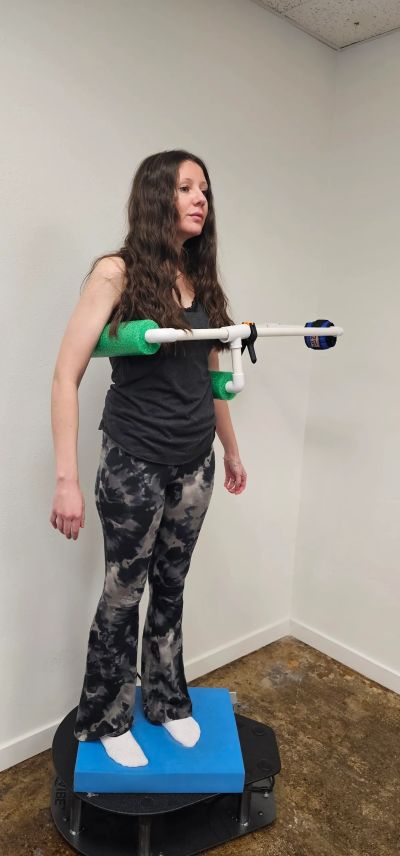
Spinal weighting & whole-body vibration therapy combine to re-train
the brain’s patterns of walking, standing, and relating to gravity. This
active re-training process is a vital component of ensuring long-term
results.
The Scoliosis Traction Chair combines traction with de-rotation and lateral traction to create a mirror image position of the scoliotic spinal configuration. Whole-body vibration is used simultaneously to help the body erase its old programs and patterns of behavior, and re-train the brain and body to work together to achieve lasting correction.